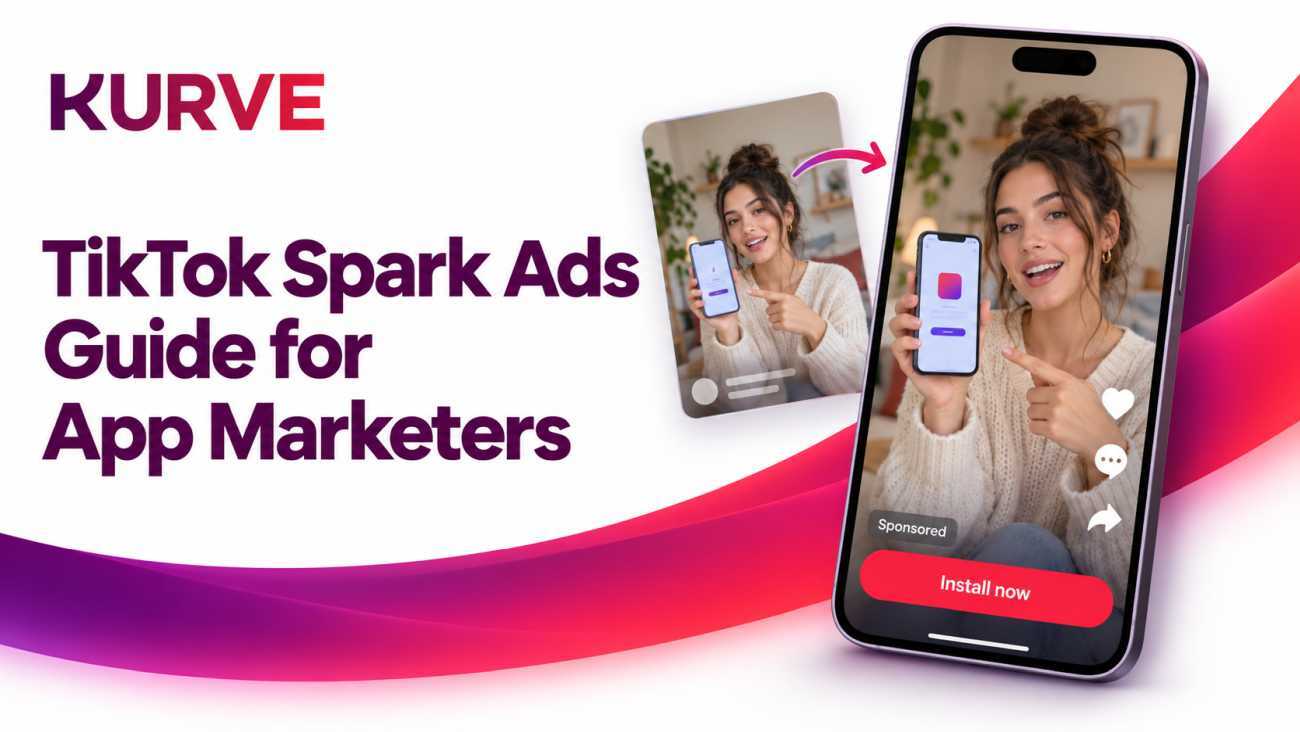
TikTok Spark Ads are a native ad format that turns an existing organic TikTok video into an ad, whether it was posted by your brand account or by a creator. The video keeps its original handle, caption and comments, and the views, likes, comments, shares and follows it earns while promoted are credited to the original post.
For app marketers, that matters because the ad looks like the content people are already scrolling through, and when paired with TikTok's App Promotion objective, a Spark Ad can include a CTA that sends viewers to the app's download page on Google Play or the Apple App Store. This guide explains how Spark Ads differ from standard ads, when they suit an app, how to set them up, and what we have seen work in campaigns we have run.
Spark Ads launched globally in July 2021, according to TikTok's Spark Ads 101 post, and TikTok's help center still documents them in 2026, so they remain a current format.
Spark Ads vs Non-Spark Ads
The main difference is where the video lives. A Spark Ad runs from a post on an authorized TikTok account; a non-Spark ad, such as a standard In-Feed ad, runs from a video uploaded inside Ads Manager.
|
Spark Ads |
Non-Spark ads |
|
|
Video source |
A post on an authorized TikTok account, yours or a creator's, either existing or pushed from Ads Manager |
A video uploaded in TikTok Ads Manager |
|
Engagement |
Views, likes, comments, shares and follows are credited to the original post |
Engagement stays on the ad |
|
Account and caption |
For an authorized organic post, the display name and caption come from the post and cannot be edited in Ads Manager |
You set the display name and ad text |
|
Follows |
Viewers can visit the profile and follow the account from the ad |
Not part of the format |
|
Call to action |
You can add a CTA button |
You can add a CTA button |
|
Creator permissions |
TikTok account or post authorization, plus separately agreed commercial usage terms |
Creator asset licensing or usage rights agreed directly |
|
Limit |
Up to 10,000 Spark Ads per Ads Manager account |
Not applicable |
This table reflects TikTok's help center page on Spark Ads and its Spark Ads 101 blog post. The same idea exists on Meta as Partnership Ads (formerly Branded Content Ads), which let you promote a creator's post on Facebook and Instagram.
When Spark Ads make sense for apps
Spark Ads fit best when you want install growth that does not depend on people searching the app store for you. TikTok's own guidance suggests boosting organic posts when you want to:
- build a following quickly and retarget those followers in lower-funnel campaigns
- run an always-on mix of organic and paid content
- scale a creator partnership by adding paid reach to branded creator videos
- keep a steady supply of native-feeling videos for a campaign
They are a weaker fit if you have no videos worth boosting yet. A Spark Ad amplifies content; it does not replace the work of finding creators and ideas that connect.
One of our clients, Bounty, shows the case for apps. Its app store ranking was already strong, so extra installs from ASO were hard to find, and Apple Search Ads fell short of the reach the team thought was possible. TikTok creator content reached busy parents in their feeds without them having to search for the app. We cover the results below.
How to set up a Spark Ad
Setting up a Spark Ad depends on where the creative comes from. TikTok currently allows advertisers to select content from a linked or authorized account, use a creator's post authorization code, or push a new creative from Ads Manager to an authorized TikTok identity. The five steps below follow the creator-code workflow, which is commonly used for influencer campaigns. TikTok's menus change often, so check each step against its current guides for Manual and Search campaigns and Smart+ campaigns.
- Agree the content first. For an existing organic post, finalize the caption and hashtags with the creator before authorization, because they cannot be edited in Ads Manager. When using the Push Spark Ads workflow, text, CTA and destination details can be added during ad creation.
- Post the video organically. It goes live on the creator's account, or on your brand account if it is your own content.
- Authorize it for ads. The account owner turns on ad authorization for that video and shares the authorization code with you.
- Build the campaign in TikTok Ads Manager. Choose your objective, such as app installs, and select the Spark Ads option at ad level. Enter the code, or pick the post from your own account.
- Add the CTA, destination and tracking details, then publish. For an authorized organic post, the account identity and original caption remain attached to the creative.
Two practical limits from TikTok's help center: each Ads Manager account supports up to 10,000 Spark Ads, and a video must be un-authorized as a Spark Ad before it can be deleted from the organic account. Tell creators this up front so nobody removes a live ad by accident.
Creative that works for app installs
In our experience, Spark Ad results depend heavily on how many creative ideas you test and how fast you drop the losers. In the campaigns we have run, a few habits repeated:
- Test volume, not one hero video. Within each testing cycle only a few videos meet the success criteria, so more videos means more chances of finding a winner. For Treecard, we tested at least 10 new videos every week.
- Separate testing from scaling. Keep new videos in a testing group, then move the ones with the best conversion rate and lowest cost per install into a group of winners that gets the budget.
- Give creators freedom. On Bounty we avoided scripted content and let creators speak from their own experience of the app, which showed which features users cared about.
- Check which creators convert. On Bounty the best-performing videos came from established creators with larger audiences. We cut the number of Spark Ads and went back to the creators who had converted best.
- Use TikTok's own signals. For Treecard we used TikTok's Video Insights tool to see how and when people engaged with each video, and fed that back into creator briefs.
TikTok's guidance on top Spark Ads adds a few basics: authentic, positive storytelling, timely trends and effects, text overlays, and sound-on audio.
Working with creators
Creator-led Spark Ads depend on picking creators whose audience matches your app and agreeing terms before anything goes live.
- Shortlist for fit. For Treecard, we pre-selected creators for brand compatibility and for viral patterns on their accounts, meaning a consistent number of videos with significant views and likes. For Bounty, we used TikTok Creator Marketplace and checked each creator's hashtags and videos.
- Brief lightly. Share the key message and the app features that matter, then leave room for the creator's style. Where we had data from TikTok's Video Insights, we added it to briefs to lift conversion on later videos.
- Agree the terms in writing. Cover the fee, how long you may run the video as an ad, who approves the caption and hashtags, and how long the authorization lasts.
- Plan for the long term. Creators whose videos convert are worth keeping. Bounty's results improved when we went back to the creators with the highest conversion rates, and turning them into brand ambassadors is an option.
For more on sourcing creators and running briefs, see our page on app influencer marketing.
Measuring Spark Ads results
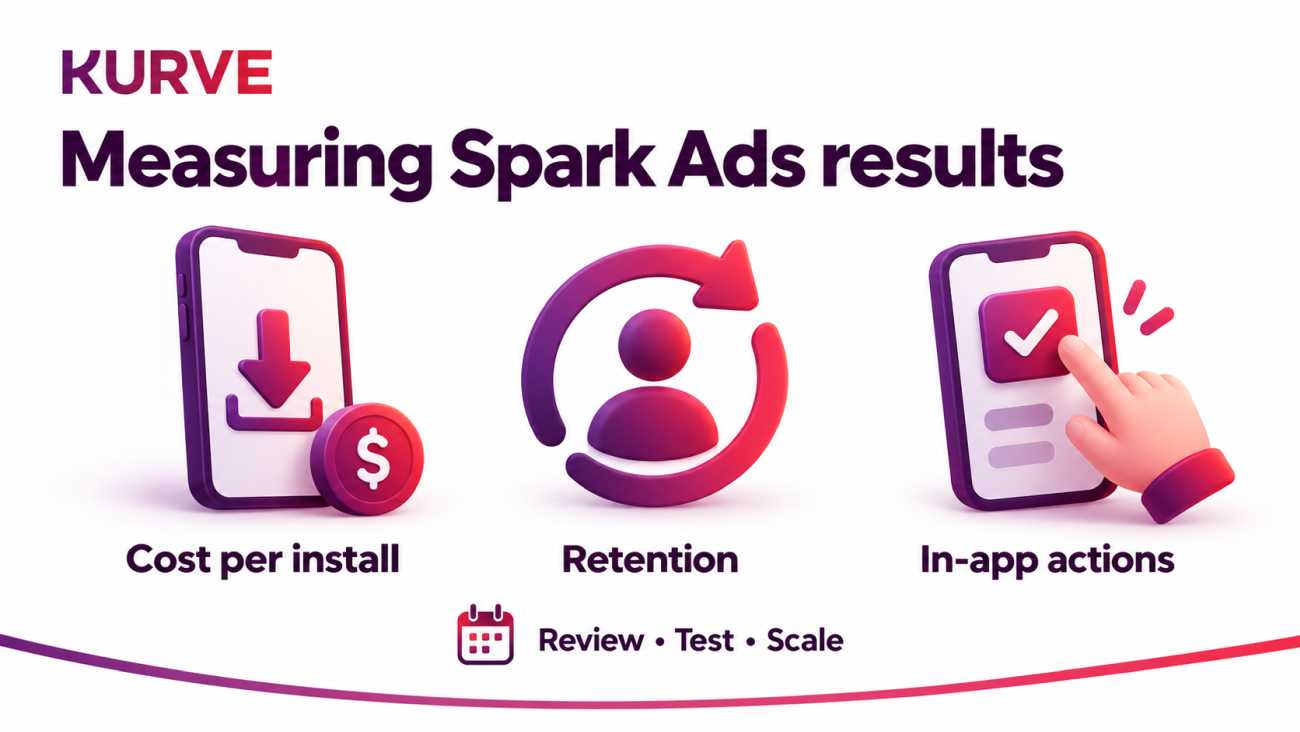
Judge Spark Ads on cost per install and on what installers do next, not on views. We track cost per install, engagement rate and retention, and where the app has a key early action, the cost of that action too. For Treecard that was the cost of getting a new user to start the in-app Walk to Plant campaign.
- Review on a fixed cycle. Treecard videos were analyzed over seven days before moving winners into the scaling group.
- Watch for fatigue. We followed each video's performance over 30 days so a winner was not pushed past the point where the audience tired of it.
- Read ad data and post data separately. Because engagement is credited to the organic post, compare Ads Manager's ad-level reporting with the post's own numbers so paid and organic effects are not mixed up.
- Connect installs to a measurement partner. Install and in-app event data should come from your attribution setup, not only from TikTok's dashboard. See our guide to mobile app attribution.
Spark Ads results from Kurve campaigns
Both campaigns below ran in 2023 and used creator Spark Ads to drive app installs. Results are as reported in each case study, with the dates they cover.
|
Market |
US |
UK |
|
Period |
3 January to 6 March 2023 |
February to August 2023 |
|
Installs |
+1,027% |
67x increase |
|
Cost |
−63% cost per install, with spend up 327% |
−75% cost per install |
|
Creative approach |
About 100 creator Spark Ad videos sourced over two months; at least 10 new videos tested each week |
Unscripted creator videos; best performers kept and scaled |
Treecard. The app wanted to grow in the US. We split TikTok creative into a testing group and a winners group, tested at least 10 new creator videos a week, and moved the lowest-cost performers into the winners group. Installs rose 1,027% while cost per install fell 63%, even as spend increased 327%. Treecard's co-founder and CEO described the results as "astonishing, and orders of magnitude better than other agencies we've worked with."
Bounty. Bounty already ranked well in the app stores, so we moved budget to TikTok creator videos aimed at new parents in the UK. Installs rose 67x and cost per install fell 75%. One video from a UK-based creator generated 27 million views and also caught the attention of US-based mums. Our case study reports that the campaign acquired 25% of the approximately 40,000 new mums entering the UK market each month.
Read the full write-ups: Treecard and Bounty.
TikTok Spark Ads FAQ
What are Spark Ads on TikTok?
Spark Ads are ads made from existing organic TikTok posts, either your own or a creator's. They keep the post's handle, caption and comments, and engagement is credited to the original post.
Do TikTok Spark Ads still exist?
Yes. TikTok's help center documents Spark Ads and shows a last-updated date of June 2026. The format has been available globally since July 2021.
Do creators get paid for Spark Ads?
Creators are paid under the agreement you make with them. Your ad spend goes to TikTok, not to the creator, so agree the fee, the period you may run the video as an ad and the authorization length before the video goes live.
Are Spark Ads worth it for apps?
They can be, if you have creator or brand videos worth boosting and a way to track installs. In our 2023 campaigns for Treecard and Bounty, cost per install fell by 63% and 75%. Those are results for two specific campaigns, not a promise, so start with a small test budget and compare Spark Ads against your standard In-Feed ads.
Can I run Spark Ads from my own videos?
Yes. You can boost posts from your own brand account as well as authorized creator posts.
Get help with Spark Ads for your app
Kurve runs TikTok and Meta campaigns for app growth, including creator sourcing, creative testing and install reporting. Our Treecard TikTok work was shortlisted at the Shorty Impact Awards and won the Silver Honor in the TikTok category.
If you want a second opinion on your TikTok setup, book a free app audit or read about our paid social services for apps.
For wider TikTok advertising, see our step-by-step TikTok advertising guide and our guide to UGC for app growth.
Sources
Campaign dates, results and process details are as reported on each Kurve page. Platform details are from TikTok's own documentation.
Kurve pages
- Treecard case study: US campaign, 3 January to 6 March 2023, testing process and results
- Bounty case study: UK campaign, February to August 2023, creator approach and results
- Paid social for apps: the Shorty Impact Awards note
External sources (TikTok)
- TikTok Help Center: About Spark Ads: the 10,000 Spark Ads limit, un-authorizing before deleting a post, engagement credited to the original post, and captions that cannot be edited
- TikTok for Business: Spark Ads 101: the July 2021 launch, when to boost organic posts, and creative tips
- TikTok Help Center: How to create Spark Ads for Manual and Search campaigns
- TikTok Help Center: How to create Spark Ads for Smart+ campaigns
- TikTok Help Center: Video Insights: the tool used to analyze video engagement in the Treecard campaign
External sources (other)
- TRIBE: What are TikTok Spark Ads?: background, including the comparison with Meta's Partnership Ads
- Strike Social: TikTok Spark Ads vs. Non-Spark Ads
- UGC Shop: The TikTok Spark Ads Guide for Creators and Businesses
- Shorty Awards: Kurve x Treecard, TikTok for Green Impact
Last reviewed: October 2026. TikTok's menus and workflows change, so check TikTok's current documentation before launching a campaign.