A UGC ad is paid creative built from content made by a customer, user or commissioned creator and designed to feel native to the platform. Genuine customer UGC and commissioned creator content are not identical, although the advertising industry often groups both under the UGC label. The three examples in this guide are commissioned creator content. For apps, the strongest ones show someone using the app and explaining in their own words why it is worth installing.
Most lists of UGC ad examples feature big consumer brands in beauty and fashion. This guide looks at three app campaigns we ran at Kurve, in finance, parenting and sustainability: what the creative looked like, how we built it, and what you can copy. Each example shows its dates and reported results. All three campaigns ran in 2023, so treat the numbers as specific outcomes, not benchmarks for today.
For the process side of UGC, including briefing and testing cadence, see our guide to UGC for app growth.
What makes a UGC ad work for an app
A UGC ad works when a viewer can tell within the first seconds what the app does and why a real person likes it. The same elements show up in all three examples below.
- A hook that sounds human. The opening line or visual should feel like a friend talking, not a banner shouting. Our guide to choosing app ad hooks covers how to pick them.
- One job per video. Decide whether the asset is a cold scroll-stopper or a closer for people who already know the app, and keep to a single message.
- Proof the viewer can see. That might be a screen recording, a real outcome or a specific story from the creator's own experience.
- A native, unscripted feel. In every campaign below, creators had room to speak in their own style instead of reading a script.
- A promise your store page keeps. If the listing does not match what the ad says, the extra installs leak away.
A short, specific brief is what ties these together. Our post on how to write a UGC creator brief shows the structure we use.
Example 1: Treecard, testing creator videos at volume
Campaign: US, 3 January to 6 March 2023.
Reported results: installs up 1,027%, cost per install down 63%, with spend up 327%.
During the 2023 campaign, Treecard planted one tree for every 10,000 steps tracked through its Walk to Plant campaign and one for every $50 spent on its planet-friendly debit card. The team wanted to grow in the US and narrowed its goals to two: driving installs and getting new users to plant their first tree through the Walk to Plant campaign.
The creative. We sourced creator videos on TikTok and promoted the best of them as Spark Ads. Creators were pre-selected for brand fit and for a consistent pattern of videos with significant views and likes, and they were given a lot of freedom to produce their own ideas. Over two months our influencer team sourced around 100 creator videos.
The system behind it. On average, 10 creator videos went into a testing group each week. After seven days of data, the videos with the lowest cost per install and cost per Walk to Plant action moved into a separate winners group. As winners moved across, we sourced more videos so that at least 10 new ones were always in test.
What to copy:
- Treat each video as a test. Within a cycle only a few assets meet the success criteria, so volume raises your odds.
- Keep testing and scaling separate so winners get budget without slowing down new ideas.
- Use platform data in your briefs. We used TikTok's Video Insights tool to see how people engaged and fed that into briefs for new videos.
Read the full Treecard case study for the detail behind these numbers.
Example 2: Bounty, unscripted first-hand creator videos
Campaign: UK, February to August 2023. Reported results: 67x install increase, cost per install down 75%, and one video that reached 27 million views.
At the time of the campaign, Bounty supported parents through pregnancy and early parenthood, and wanted more brand awareness and installs in the UK. Our research found a large audience of mums talking about their experiences on Facebook, Instagram and TikTok. We tested ASO and Apple Search Ads first. Bounty was already well known and ranking high in the app stores, so extra installs from ASO were hard to find, and Apple Search Ads delivered good results but fell short of the reach we thought was possible. TikTok creator content could reach busy parents in their feeds, so they did not need to search for the app.
The creative. We pre-selected creators through TikTok Creator Marketplace, checking their hashtags and videos for fit, and at first worked with creators at every follower level. We gave them full freedom and avoided scripted content. Bounty has a history of over 60 years, so we looked for creators who were new to the app as well as parents who already used it and could describe their ongoing experience first-hand.
What the data said. The best-performing videos came from established creators with larger audiences who were genuinely enthusiastic about Bounty. We reduced the number of Spark Ads, put resources behind higher-quality videos, and in the last two months went back to the creators with the highest conversion rates.
The result beyond installs. One video from a UK-based creator generated 27 million views and caught the attention of US-based mums. Our case study reports that the campaign acquired 25% of the approximately 40,000 new mums entering the UK market each month. Working with creators also showed Bounty what its audience cared about, and the brand widened its message from prenatal features to postnatal baby care.
What to copy:
- Test the channels you already know before assuming UGC is the answer, as we did with ASO and Apple Search Ads.
- Let creators speak from real experience instead of scripting them.
- Start broad on creator size, then follow the conversion data.
Read the full Bounty case study.
Example 3: Beanstalk, authentic testimonials in a regulated category
Campaign: UK, January to March 2023. Reported results: customer acquisition cost down 66%, new accounts up 4x month on month, and 87 Spark Ads sourced in three months.
In 2023, Beanstalk was a Junior ISA app that helped families save for their children's future. Because the offer pays off over the long term, the team needed growth that kept a healthy ratio of lifetime value to acquisition cost. Interviews run by the Beanstalk team, combined with our audience and channel research, showed that unscripted, authentic user testimonials posted organically on TikTok were the best way to reach new parents.
The creative. We sourced creator videos and promoted them as Spark Ads. To pick creators, we reviewed their latest 30 videos for patterns of views, likes and shares, and checked that their audience matched features of the app that would interest them, such as mums sharing everyday family life. TikTok's Video Insights data on the highest-converting videos shaped our briefs.
The compliance limit. Challenges with prizes can build buzz on TikTok, but Beanstalk offered a regulated product, so we avoided them. Instead we made sure every creative described the app's features and the potential investment risks accurately.
A practical detail. During the 2023 campaign, TikTok direct messages were not practical for the creators we wanted to reach, so we ran creator outreach manually on Instagram.
What to copy:
- Ask your own users first. Interviews told the team what kind of content would land before any budget was spent.
- If your app is regulated, agree what creators can and cannot say before filming, not after.
- Do not rely on a single outreach channel. Use whichever one the creator actually answers.
Read the full Beanstalk case study.
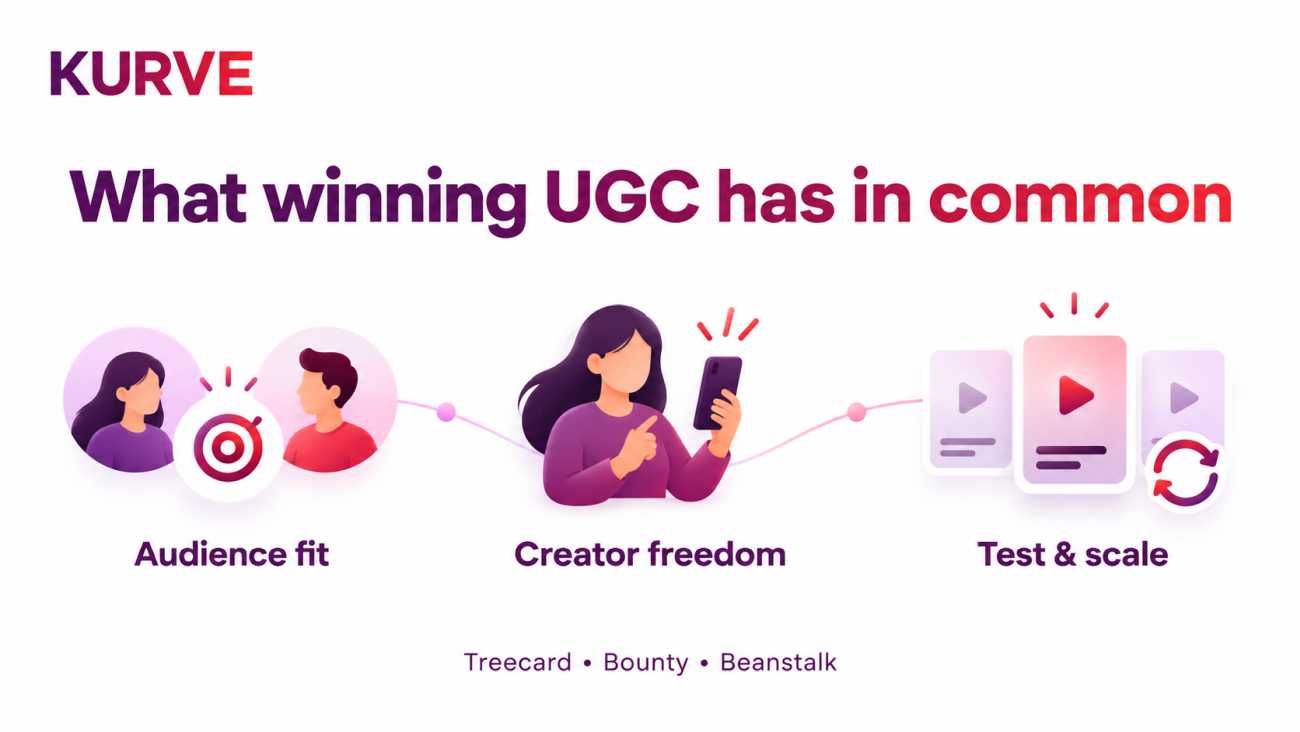
What the three campaigns have in common
The campaigns differ by market and category, but the way the creative was built is similar.
|
Treecard |
Bounty |
Beanstalk |
|
|
Market and dates |
US, 3 Jan to 6 Mar 2023 |
UK, Feb to Aug 2023 |
UK, Jan to Mar 2023 |
|
Creator selection |
Brand fit plus a pattern of viral videos |
TikTok Creator Marketplace, hashtags and video review, all follower levels at first |
Latest 30 videos reviewed for virality, audience matched to app features |
|
Creative direction |
Freedom to produce own ideas, briefs shaped by Video Insights |
Unscripted, first-hand experience of the app |
Unscripted, authentic user testimonials with accurate feature and risk wording |
|
How winners were found |
Weekly test group, winners group after seven days |
Dropped weaker videos, rebooked top converters |
Measured impact to pick videos to scale within CAC |
|
Reported result |
Installs +1,027%, cost per install −63% |
Installs 67x, cost per install −75% |
CAC −66%, new accounts 4x month on month |
Three patterns repeat. Bounty and Beanstalk started with audience research before creators were briefed, and Treecard began with a testing period that reset its goals. Each gave creators freedom instead of a tight script. And each treated results as a loop: test many videos, keep the ones that convert, and go back to the creators behind them.
Rights, approvals and moderation
UGC is only as safe as the permissions behind it. Settle these points before a video becomes an ad:
- Usage rights. Get written permission covering paid use, platforms, duration, territory and permitted edits. Confirm that any music, footage, images or other third-party elements are also cleared for the intended advertising use. Our influencer contract checklist for apps lists what to cover.
- Account authorization. If you promote a creator's post as a Spark Ad, the creator has to authorize it for ads. That is separate from the commercial agreement.
- Claims and compliance. In a regulated category like Beanstalk's, agree what creators may say up front and check the finished video against it.
- Comments. Engagement stays attached to the original post. Where comments are enabled, decide who will monitor them and how the brand will respond.
- Review before you scale. Before putting spend behind a winner, read our guide to auditing app ad creative before scaling spend.
Finding creators and briefing them
The three campaigns used the same basic steps to find creators and set them up to succeed.
- Build a shortlist. Search the Creator Marketplace in TikTok One and relevant hashtags, then review each creator's recent videos for views, likes, shares and commercial fit. Our guide to building an app influencer shortlist walks through it.
- Check fit. Make sure the follower base matches the app features you want to talk about. See how to vet influencers before hiring them.
- Pick a source. Decide whether you need creators, existing users or a mix. UGC vs influencer marketing and how to choose the right UGC platform can help you choose.
- Agree pricing. Budget for the number of videos you will need to test. We cover current rates in how much app brands should pay for UGC creators in 2026.
- Write a short brief. State what the video must do, what must be true, how it should feel and what proof to show. Use our UGC creator brief guide.
If you would rather hand the work to a team, see Kurve's app influencer marketing and creative support services.
UGC ad examples FAQ
What is an example of a UGC ad?
A UGC ad is a paid ad made from a creator's or customer's video. In Bounty's campaign, commissioned creators spoke on camera about their own experience with the app, and the best of those videos were promoted as ads.
Is UGC still a thing in 2026?
Yes. TikTok still builds tools for working with creators, and its Creator Marketplace now sits inside TikTok One, its creative platform. The campaigns in this guide ran in 2023, so their costs and results should not be treated as current benchmarks. Start with a controlled test and measure post-install quality before increasing spend.
How many UGC videos should I test?
There is no fixed number. Treecard tested at least 10 new creator videos a week, and Beanstalk sourced 87 Spark Ads in three months. What matters is having enough variety to find winners and a clear way to measure them.
Can I use customer content in ads?
Yes, with written permission to use it in paid ads. Customer content often varies in quality, so many teams brief creators for the content they need and use customer stories as proof points. Our guide to UGC for app growth explains how to turn existing users into a source of testimonials.
What is the difference between UGC and influencer content?
Genuine UGC is created voluntarily by real customers or product users. UGC-style creator content is commissioned mainly as an asset for the brand to use in its own channels or paid advertising. Influencer content is often purchased partly for access to the creator's established audience. The formats can overlap when an influencer creates native-style content that the brand later promotes. Our post on UGC vs influencer marketing explains how to choose.
Get UGC ads working for your app
Kurve sources creators, runs creative tests and reports on installs for app teams. If you want a second opinion on your current UGC, book a free app audit or read about our paid social services for apps.
For more on creative, see our creative strategy and research service and our guide to UGC for app growth.
External sources (TikTok)
- TikTok Help Center: Spark Ads: how Spark Ads work, and why a creator has to authorize a post for ads
- TikTok Help Center: Video Insights: the tool used to analyze video engagement in the Treecard and Beanstalk campaigns
- TikTok One: TikTok's creative platform
- TikTok Creator Marketplace: where creator discovery now sits within TikTok One
External sources (UGC examples)
Other roundups of UGC ad and video examples, from outside Kurve:
- Cohley: 100+ UGC video examples
- Digital Marketing Institute: 4 Great Examples of User-Generated Content (UGC)
- Influee: UGC Ads: Create Ads That Work (+ Examples)
- Insense: 11 UGC Video Examples
- Yotpo: 10 UGC Examples To Drive Sales & Build Trust
- Zeely: 27 best real UGC video ads examples
Last reviewed: October 2026. Platform tools and costs change, so check current figures before planning a campaign.