Choosing an ASO agency comes down to seven checks: a testing process that never stops, proof in a category like yours, a link to paid search, localization depth, reporting you can check yourself, tactics the app stores allow and a clear method. This guide covers what ASO agencies do, how they work, what to ask before you sign and which red flags should end the conversation.
A note before you start: Kurve is an app growth agency that offers ASO, so we have a stake in this decision. The checklist below is the one we would want any agency, including us, to pass.
In this guide: What an ASO agency does · Types of ASO agency · What to look for · Questions to ask · Red flags · Engagements and pricing · The first 90 days · How Kurve approaches ASO · FAQ
What an ASO agency does
An ASO agency improves how your app ranks and converts in the Apple App Store and Google Play. If you need a refresher on what app store optimization is, read our guide first.
Most ASO agencies cover the same core work:
- Keywords and metadata: researching the terms people search for and writing your title, subtitle, keyword field and descriptions around them.
- Creative: icons, screenshots and preview videos, and testing which versions convert better.
- Localization: adapting keywords, text and visuals for each market.
- Ratings and reviews: monitoring sentiment and replying to users.
- Reporting: keyword rankings, store conversion rate and organic installs.
Some agencies also run Apple Search Ads next to ASO. Paid search data shows which keywords actually convert, which helps decide what to target organically.
Types of ASO agency
ASO agencies differ in what they cover and how they work. None of these models is better by default, so match the model to your team.
- Specialist or full-service. A specialist works only on the app stores. A full-service app growth agency runs ASO alongside paid acquisition, creative and retention, so learnings from one channel can feed another. A specialist may go deeper on store tactics; a full-service agency sees more of your growth picture.
- Retainer or project. A retainer covers continuous work: testing, updating metadata and reporting every month. A project, such as an audit or a localization plan, gives your team a plan to carry out.
- Keyword-led or creative-led. Some agencies focus mainly on keywords and metadata, others on icons, screenshots and videos. Keywords decide what you rank for, and creative decides whether people install, so look for an agency that does both.
- Agency or consultant. An ASO consultant is usually one specialist who advises your team. That works well if you have people to make the changes. An agency brings a team to do the work.
- Own tools or third-party tools. Some agencies build their own software. Most use third-party ASO tools. Either is fine, but ask which ones they use and whether you get access to the data.
What to look for in an ASO agency
Look for seven traits, and use them as a scorecard when you compare proposals.
- A testing process that keeps going. Apple and Google change how they rank and feature apps, and competitors keep updating their listings, so ASO is never finished. Look for an agency that keeps testing creative, such as icons, screenshots and videos, using Apple's product page optimization and Google Play's store listing experiments, and that revisits keywords as rankings change. Our guide to A/B testing your store listing explains how both work.
- Proof in your category, with dates. Ask for case studies from apps like yours, showing the market, the period and the metric that changed. A percentage with no date or market tells you very little.
- A link to paid search. Apple Search Ads data shows which keywords turn into installs, which helps decide what to target organically. An agency that can use that data, or works with your paid team, has an edge. Our Apple Search Ads best practices cover how the two fit together, and our Treecard work below shows them run side by side.
- Localization depth. If you sell in several markets, ask whether the agency adapts creative as well as text, and how it researches each market. Our guide to mobile app localization covers the basics, and our Sweatcoin work in Japan below started with this kind of market research.
- Reporting you can check. Expect named metrics, such as keyword rankings, store listing conversion rate, organic installs and test results. The best source is your own App Store Connect and Google Play Console data, which you control.
- Tactics the stores allow. The agency should follow Apple's App Store Review Guidelines and Google Play's policies. That rules out paying for reviews, buying fake installs and stuffing keywords.
- A clear method. Ask the agency to walk you through its audit and its first month. Compare what it promises against our ASO checklist to see what it might be leaving out.
Questions to ask before you sign
These questions surface real differences between agencies faster than a sales deck:
- Which apps like ours have you worked with, and what changed, in which market and over what period?
- What will you do in the first 30, 60 and 90 days?
- How do you decide what to test, and how many tests do you expect to run?
- How do you handle markets where our app is not well known?
- Who will work on our account day to day?
- Which tools do you use, and will we see the underlying data?
- What do you report, how often, and how do you separate organic installs from paid ones?
- What does the fee include, such as creative production, localization or Apple Search Ads management, and what costs extra?
- What is the notice period?
Red flags when choosing an ASO agency
Walk away, or at least ask harder questions, if you see any of these:
- Guaranteed rankings or download numbers. No agency controls the app store algorithms.
- Fake reviews, paid installs or keyword stuffing. These break store rules and put your app at risk.
- No questions about your product. An agency that jumps straight to keyword lists without asking about your users, competitors and goals is guessing.
- One package for every app. A new app in one market needs a different plan from a global app with millions of users.
- Vague reporting. Summaries without named metrics, or numbers only from the agency's own dashboard.
- No access to your data or assets. You should keep your store accounts, your creative files and your test history.
- Long lock-ins. A contract you cannot leave before there has been time to judge results.
- Case studies with no dates or markets. If the agency cannot say when and where a result happened, treat it as unproven.
How ASO agency engagements and pricing work
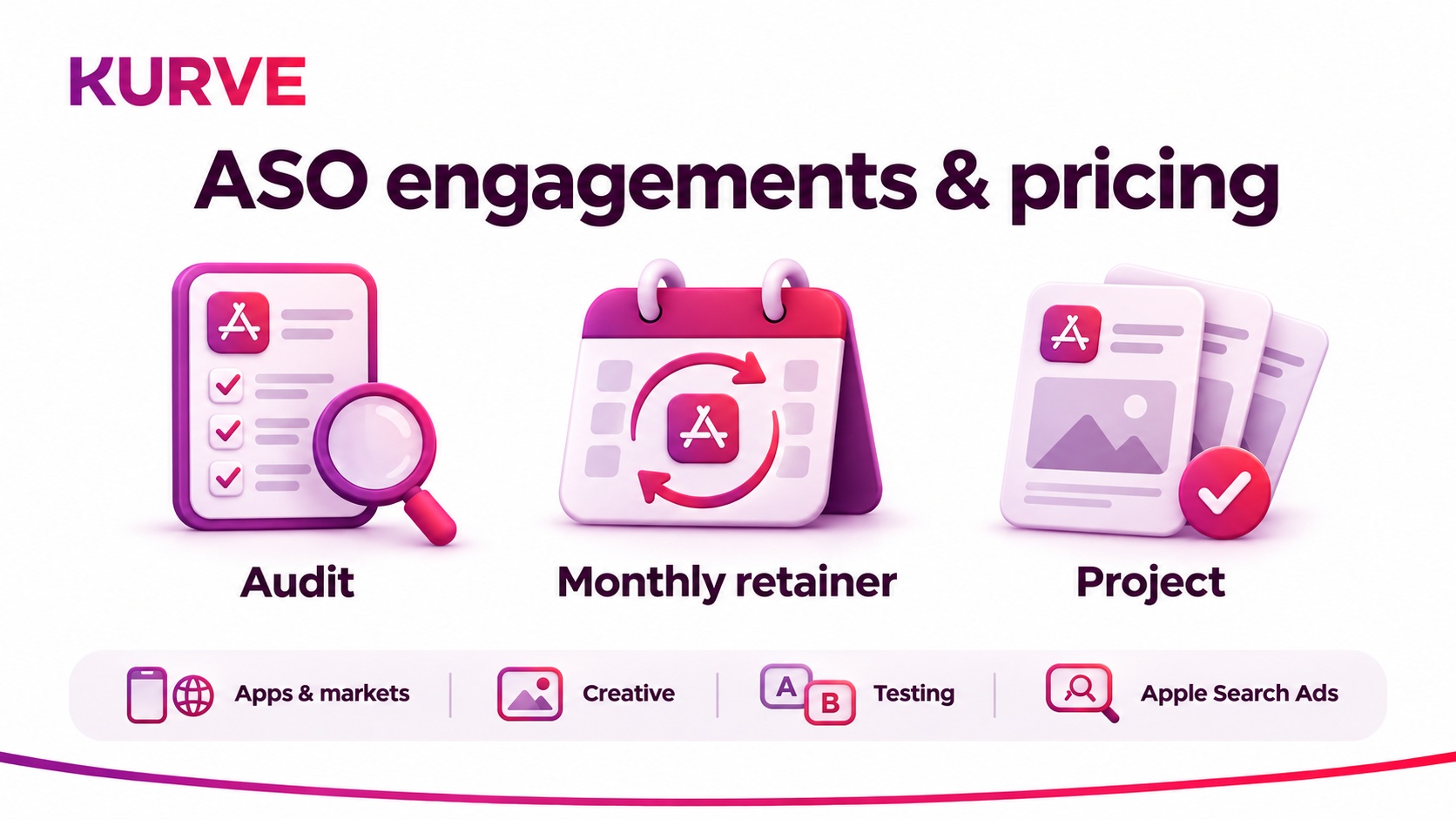
Most engagements start with an audit and then move into a monthly program or a defined project.
- Audit: a review of your keywords, metadata, creative, ratings and competitors, ending in a prioritized plan.
- Monthly retainer: ongoing keyword updates, creative tests, localization and reporting.
- Project: a fixed scope, such as launching in a new market or redesigning your screenshots.
Price depends on scope more than on the agency's name. The main drivers are:
- how many apps, stores and markets are covered
- how much creative the agency designs and produces
- how often it runs store tests
- whether Apple Search Ads management is included
Ask for a written scope that also lists what is not included. For typical ranges and what affects them, see our guide on how much ASO costs.
Editor note: add Kurve's starting price, its period and what it includes once the team confirms them. Do not publish a figure before then.
What a good first 90 days looks like
The schedule below is an illustration, not a benchmark. It shows the shape of a healthy start.
- Month 1: audit, baseline numbers (rankings, conversion rate, organic installs), the first metadata update and a test plan.
- Month 2: the first creative tests running, and keyword changes measured against the baseline.
- Month 3: results reviewed, winning versions rolled out, the next tests planned and localization started where it matters.
Metadata changes and store tests both take time to show results, and smaller apps need longer for a test to reach a clear answer. In the first months, judge an agency on whether it follows the plan and reports honestly, not on one ranking jump.
How Kurve approaches ASO
Two examples show how we apply the checklist above. Both come from our published case studies, with their dates.
Treecard: ASO and Apple Search Ads together (US, January to June 2023). We researched competitors' keywords, reviewed the keyword set every two weeks, used exact match to test keywords and broad match to find new ones, added negative keywords, and moved the app's App Store category from banking to fitness. Over the period, Treecard's visibility score rose 419%. Its Apple Search Ads campaigns delivered more than 25,000 installs from over 1.7 million impressions, while average monthly cost per acquisition fell 68%. That last figure is a paid search result, not an organic one. Read the Treecard case study for the full detail.
Sweatcoin: localizing for Japan. Sweatcoin asked us to help localize its App Store assets for Japan, where its conversion rates differed from other regions. We studied competitors' localized screenshots and their test activity using data.ai, AppTweak and MobileAction, and compared how global brands present themselves in the US and Japan. Our recommendations, including denser screenshots that combine visuals and text, vibrant colors and strong social proof, shaped the assets Sweatcoin's team then created and tested. As Irina Ashkenazy, Sweatcoin's Head of Growth, put it: "Implementing Kurve's ASO insights at the time of our launch in Japan enabled us to create a familiar and native brand perception in this new market." Read the Sweatcoin Japan case study.
If you want a team that works this way, see our ASO agency services or book a free ASO audit.
ASO agency FAQ
What does an ASO agency do?
It improves how your app ranks and converts in the App Store and Google Play, through keyword research, metadata, creative testing, localization, review management and reporting.
How much does an ASO agency cost?
It depends on scope: how many apps, stores and markets are covered, how much creative is produced and how often the agency tests. Ask for a written scope with inclusions and exclusions.
What is the difference between ASO and SEO?
SEO improves visibility in web search engines. ASO improves visibility in app stores, which have their own ranking factors and metadata fields, such as the title, subtitle and keyword field, and where screenshots and store conversion matter far more.
What is an ASO specialist?
Someone who researches app store keywords, writes metadata, plans creative tests and reads store data. ASO specialists work in-house, freelance or at agencies.
How long does ASO take to work?
It depends on your traffic and category. Some changes show within weeks, while steady growth builds over months of testing. Early on, judge progress by whether the plan is followed and reported clearly.
Should I hire an ASO consultant or an agency?
Hire a consultant if you have people who can make the changes and you want expert direction. Hire an agency if you also need the hands to do the work, including creative production and testing.
Can I do ASO in-house instead of hiring an agency?
Yes, if you have someone with time to research keywords, produce and test creative, and follow store changes. An agency adds a team, tools and experience from other apps. Many teams start with an audit to see which route fits.