I’ve spent a decade in the operational trenches, watching products thrive or fail from our corner of London. To build a successful entry into the market in 2026, you need more than a good idea; you need a surgical process.
I’ve seen dozens of teams pour their life savings into development only to see their creation vanish because they skipped the foundational marketing strategies that make a launch actually stick. This is my attempt to download our marketing strategy at Kurve into a single, practical guide.
Table of Contents
- The 2026 Landscape
- Winning Strategies for Discovery
- Winning at User Acquisition
- User Retention and Engagement
- Perfecting the App Preview
- Managing App Submission
- Acting on User Feedback
- App Use Insights
- FAQ
The 2026 Landscape for an App Launch
We’ve moved past simple installs. Today, we build on AI-Driven Market Intelligence. This means using data to predict how a niche target audience will react to an interface before we even build the final version.
I recently worked with a founder who was obsessed with Predictive Persona Mapping. We weren't just looking at demographics; we were looking at "Vibe Coding." If your software doesn't match the emotional frequency of the social platforms where you advertise, you are invisible. This app development phase requires thinking about Integration Testing for 5G/IoT from day one. We often help clients validate a new concept using these high-stress scenarios to ensure the application is robust.
Winning Strategies for Discovery
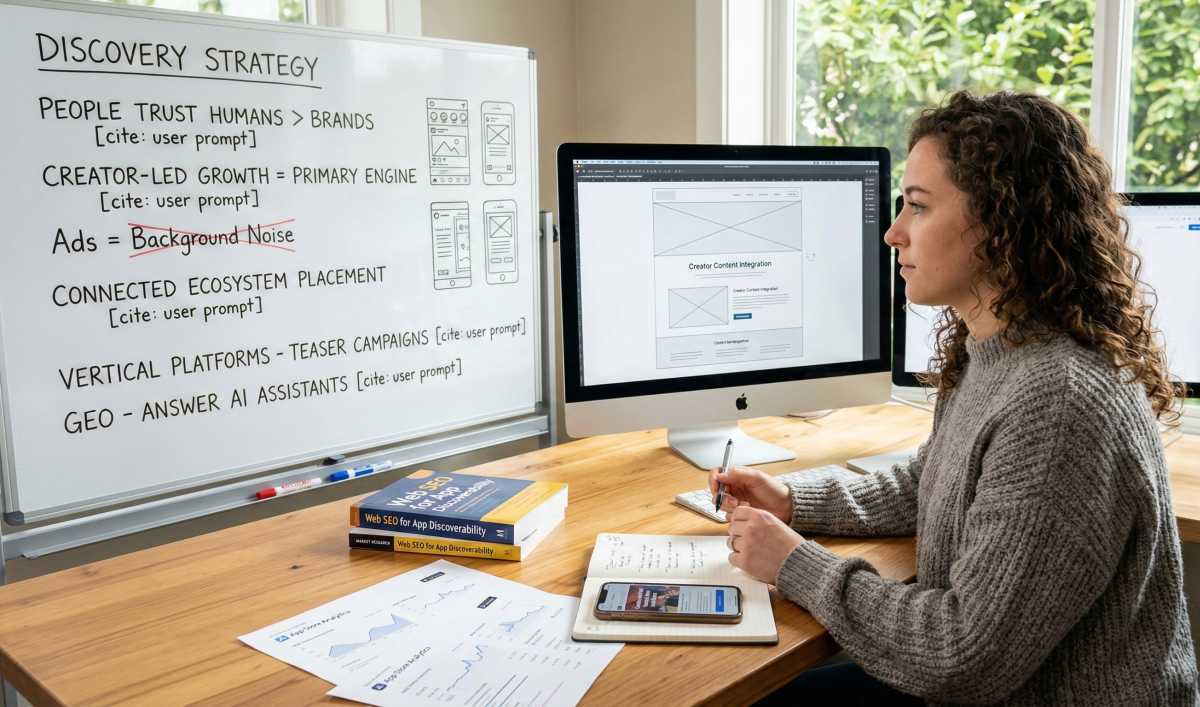
In your marketing strategy, you have to realise that traditional ads are becoming background noise. People trust humans, not brands. That is why Creator-Led Growth is the primary engine of app marketing this year.
I’ve seen a single creator drive more high-value users than a six-figure billboard campaign. But you can't just throw money at people. You need Teaser Campaigns on Vertical Platforms that feel like part of the social culture. This is part of a larger effective mobile app marketing effort that requires Connected Ecosystem Placement. Your product should show up naturally where your users hang out.
We also focus on Technical SEO for App Landing Pages. Even if your product lives in the store, people search for solutions on the web first. If your landing page isn't optimized for generative engine optimization, you are missing the first step. You want your business to be the answer when someone asks an AI assistant for a recommendation.
Winning at User Acquisition
The cost of user acquisition has skyrocketed. If you aren't careful, it will bleed startups dry. Operations managers look at Incrementality & MMM Tracking to ensure every pound spent is actually bringing in new users.
In the current climate, mobile app acquisition strategies need to be diverse. To make a launch successful, we use a mix of:
- Hyper-Personalized Onboarding to reduce the "bounce."
- Community-Led Advocacy to turn your first members into a sales force.
- ASO 2.0 to ensure your listing conversion rate is as high as possible.
The most successful launch events are the ones that feel like a movement. If you build a community around the problem you are solving, your users will do the heavy lifting. This is far more effective than just buying traffic.
Focus on User Retention and Loyalty
Getting the download is the easy part. Keeping them is the real work. User retention in 2026 is about AI-Native Customer Support. This isn't just a basic chatbot; it’s an integrated system that knows when a person is struggling and offers help.
We look at Continuous Feature Iteration as a daily process, not a quarterly one. You should be taking feedback and turning it into a new build within days. If you aren't listening, your users will move to a competitor who is.
We also use In-App Rating Prompts that are actually smart. Don't interrupt someone when they are trying to work. Wait for the "aha!" moment to ask for their feedback. This is a core part of any winning brand strategy. When you get this right, your users become your best marketing asset.
Perfecting the App Preview Visuals
Your app preview is essentially your shop window. In the app stores, you are competing with millions of other products. If your visuals look like an afterthought, users will assume your development is buggy too.
I’ve seen design teams spend weeks arguing over a button colour but forget to show the value of the tool in the first screenshot. Your visuals need to be properly sized for every device. A graphic that looks great on a monitor might be unreadable on a phone screen.
We always suggest a Soft Launch in Emerging Markets to test which visuals actually convert. Sometimes a "rough" video performs better than a polished studio production. You won't know until you do the testing. This is why mastering mobile app A/B testing is so vital for your operations.
Managing the App Submission
The app submission is often the most stressful week for an operations team. Whether you are dealing with apple or Google, the rules are constantly changing. You need to have your Privacy-First First-Party Data house in order. If you aren't transparent about data, you will be rejected.
I’ve had late-night calls dealing with an unexpected app review rejection because a developer used a library that didn't meet compliance standards. This is where a solid ASO checklist saves your sanity. It’s a boring process, but it is the difference between going live on time and missing your window.
Make sure your Multi-Platform Orchestration is synced. You don't want your marketing campaign to go live two days before your product is actually available in the app store. It sounds obvious, but you’d be surprised how often it happens during a launch.

Listening to User Feedback Post-Launch
Once the app launch is live, your job has only just begun. The first wave of users will find bugs you never imagined. This is where Continuous Feature Iteration saves you. You need to be ready to build and ship updates fast.
I love looking at the raw user feedback. It is the only truth in this business. We use mobile analytics tools to see exactly where people get stuck. If people drop off at the sign-up screen, your app marketing won't save you. You have a design problem.
At Kurve, we’ve seen that growth hacks for apps are only effective if the core product works. Take the feedback, fix the friction, and then turn the marketing engine back on. This cycle of testing and refining is what separates the winners.
Operational Data Comparison
|
Launch Element |
2023 Approach |
2026 Approach |
|
Intelligence |
Manual surveys |
AI-Driven Predictive Modelling |
|
Mapping |
Broad demographics |
Psychographic Vibe Coding |
|
Acquisition |
Broad Paid Social |
Creator-Led Community Advocacy |
|
Support |
Reactive tickets |
AI-Native Predictive Support |
|
Testing |
Standard QA |
Integration Testing |
App Use Insights
Looking back, it's clear that old marketing tactics don't cut it. You have to be faster and more human. Whether you are providing ecommerce development services or building a crypto platform, the fundamentals of app marketing are tied to data.
We often tell clients to focus on their Incrementality. Don't just look at the total number of users; look at the quality. Are they staying? Are they advocating for you? This is the heart of a successful mobile app growth strategy.
The process of bringing an app launch to life is a marathon. It’s exhausting and rewarding. To learn how to do it right, you have to be willing to build, test, and iterate. An app use case is only as good as the problem it solves. If you keep your focus on the person at the other end of the screen, everything eventually falls into place.
FAQ
What's the most used app in 2025?
In the current landscape, the most used software types are those that offer seamless utility, such as AI-integrated productivity tools and community-driven platforms. People are moving away from general-purpose app stores toward niche solutions.
How much can a 1000 downloads app make?
It depends on your marketing and monetization plan. A high-ticket B2B tool might make thousands from a few users, while a consumer game might only make a few pounds from ads. The key is in maximizing user retention to build long-term value in the app store.
How to create a mobile app 2025 approach?
The 2025 approach is built on AI-Native development. This means using machine learning for everything from the initial design to real-time analysis of users. It is about creating a product that learns and grows with its target audience.
How to create mobile apps that make $3,000 a day?
To hit those numbers, you need a mix of high acquisition and even higher retention. Most products that reach this level use subscription models with loss aversion tactics to keep users engaged and paying for value across all app stores.
Bringing a new product into the world in 2026 is no joke. It takes grit, a bit of luck, and a whole lot of operational discipline. If you are feeling overwhelmed by the complexity of a launch, you are in good company.
Would you like me to take a look at your current launch plan and see if we can spot any operational gaps before you go live?